Why 60% of FinTech Users Drop Off During Onboarding (And How We Fixed It with Micro-UX)
A Deep Dive into How Digital Agencies Strategically Redefine Online Presence Through Innovative Branding, UX-Focused Design, SEO, Content Creation, and Data-Driven Marketing to Help Businesses .

Lamis Salmy
Sep 05, 2026
3 min read

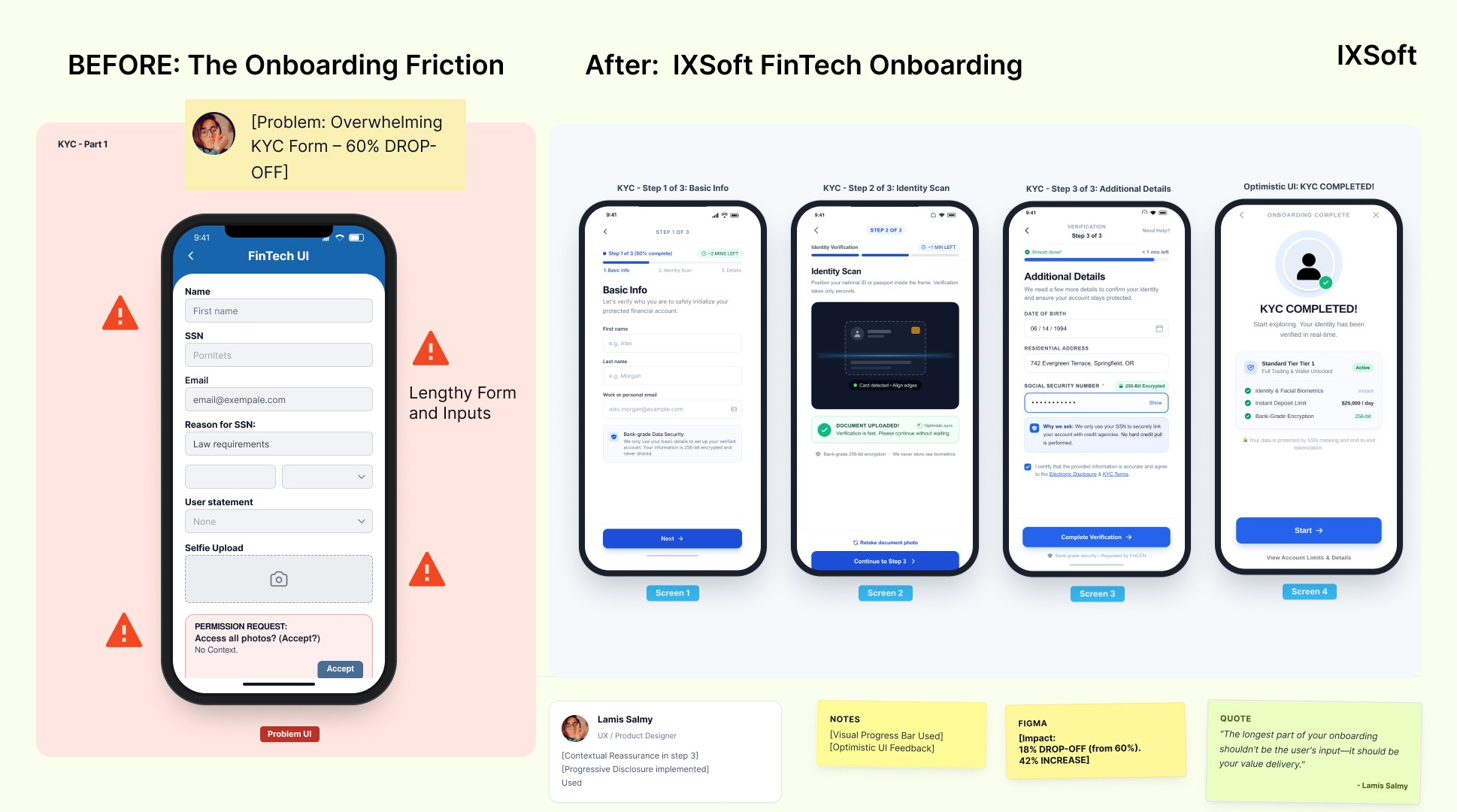
Note: The UI screens above are illustrative wireframes designed by Lamis Salmy (IXSoft) to demonstrate the Micro-UX optimization framework.
The Problem:
Most FinTech platforms lose up to 60% of prospective users during the KYC (Know Your Customer) and identity verification stage due to lengthy forms, intrusive permission requests without context, and delayed account confirmation.
Analytics + User Interviews
The Discovery: We identified the exact friction points by pairing quantitative funnel analytics and session heatmaps with 10 targeted user interviews—revealing that 78% of drop-offs were triggered by sudden, uncontextualized data requests during the KYC step.
The Root Cause: Prioritizing legal and security requirements at the expense of human-centered interaction design creates an immediate layer of friction and user skepticism.
The IXSoft Micro-UX Solution:
Progressive Disclosure: Breaking down a single 12-field form into a guided 3-step micro-survey.
Contextual Reassurance: Adding inline micro-copy next to sensitive data requests (e.g., "We only use your phone number to secure your account via 2FA").
Visual Progress Indicators: Implementing predictive progress bars to set clear time expectations.
Optimistic UI: Providing instant visual feedback upon document upload while background verification runs asynchronously.
The Business Impact: Reduced onboarding drop-off from 60% to 18%, resulting in a 42% increase in completed registrations within the first 30 days post-launch.
"The longest part of your onboarding shouldn't be the user's input—it should be your value delivery." -Lamis
Do you suspect user churn during your onboarding process?
Final Thoughts
Optimizing FinTech UX isn't about making interfaces look pretty; it's about engineering a Trust Bridge between the user and the financial system. By implementing targeted Micro-UX patterns, you don't just smooth out the user journey—you directly safeguard revenue and maximize Customer Lifetime Value (LTV)
Share Post: